
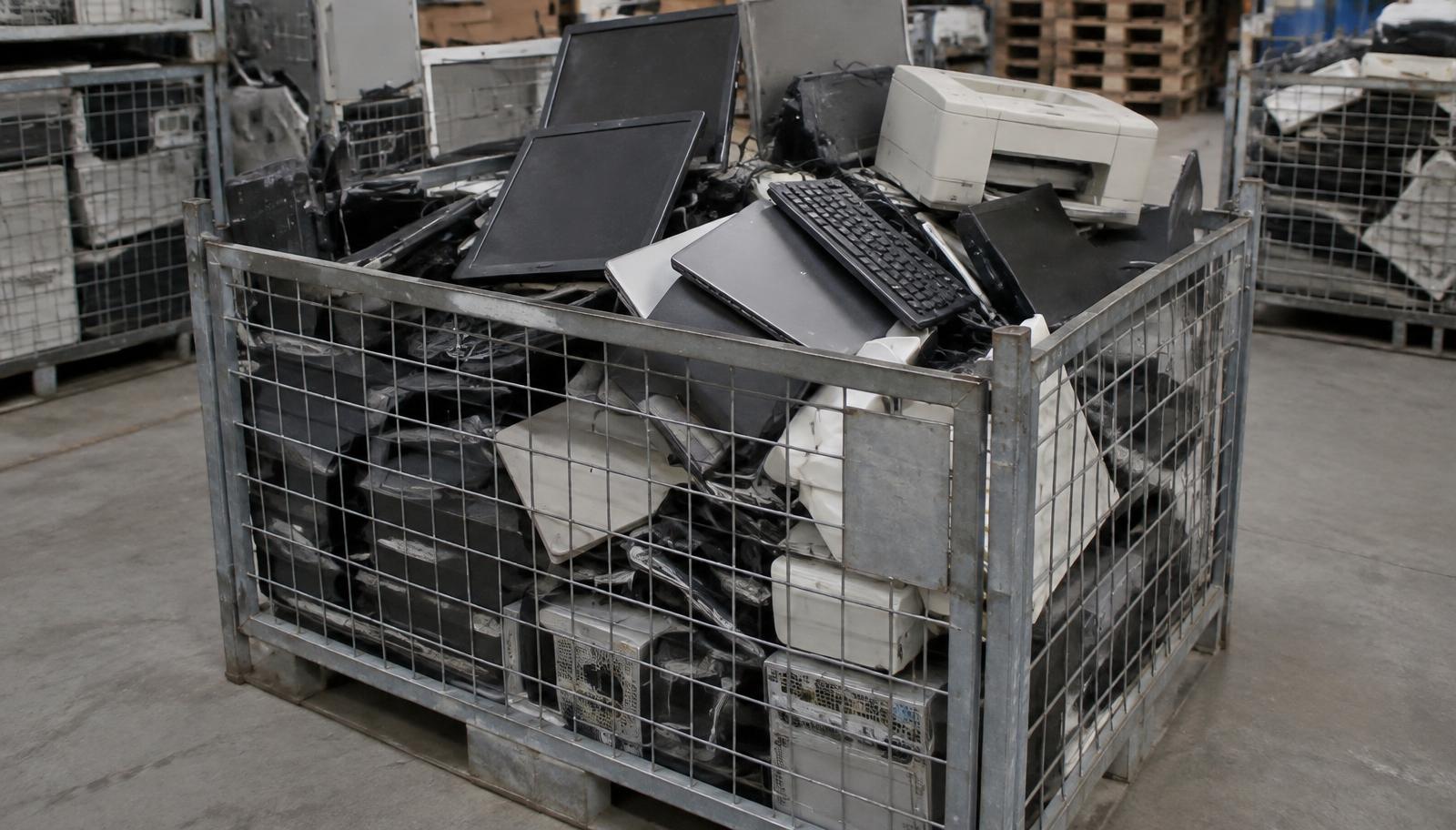
What is WEEE?
WEEE stands for waste electrical and electronic equipment. It covers almost any item with a plug, battery or cable that has reached the end of its life, from laptops, monitors and printers to fridges, lighting, power tools and vapes.
The GOV.UK guidance on the WEEE Regulations states that the regulations cover electrical and electronic equipment (EEE) in 15 broad categories. Some items are excluded, including filament bulbs (except LED filament bulbs), large industrial tools and installations, military equipment, most transport and implantable medical devices.
What is WEEE waste, and when is it hazardous?
Some WEEE is classed as hazardous waste. GOV.UK's guidance on how to classify WEEE lists examples, including:
- fridges and freezers containing ozone-depleting foam or coolants
- fluorescent tubes and other gas discharge lamps
- televisions and monitors containing persistent organic pollutants (POPs)
- heat pump tumble dryers, which contain hazardous coolants
The guidance gives separate classification codes for household and business WEEE. An asterisk at the end of a code means the waste is hazardous. Businesses must classify their WEEE before it is collected, and hazardous waste moved in England needs a consignment note under the GOV.UK hazardous waste rules.
Who has duties under the WEEE Regulations?
The Waste Electrical and Electronic Equipment Regulations 2013 place duties on several groups. They were amended in 2025.
Producers
GOV.UK defines producers as UK brand owners, rebranders, commercial importers, overseas businesses selling directly to UK users by distance selling, and online marketplace operators placing EEE from non-UK suppliers on the UK market. Producer duties include registering each year, marking products with the crossed-out wheeled bin symbol and keeping records for at least four years.
Producers placing more than 5 tonnes of EEE on the market must join a producer compliance scheme (PCS). Smaller producers can register directly with their environmental regulator.
Distributors and retailers
Distributors, including retailers and online sellers, must offer customers a free way to return old household equipment when they buy a new, similar item. GOV.UK states that retailers with an EEE sales area over 400 square metres must also take back small WEEE (under 25cm on its longest side) free of charge from households, with no purchase needed.
Retailers that sell vapes have specific collection and recycling duties. The single-use vapes ban came into force on 1 June 2025, and retailers must recycle any leftover single-use stock.
What the WEEE Regulations mean for business users
Most businesses are not producers or retailers. They are end users disposing of their own equipment, such as old IT, lighting or kitchen appliances.
GOV.UK's guidance on EEE producer responsibility explains that producers, through their compliance schemes, take on financial obligations for business WEEE from equipment placed on the market on or after 13 August 2005. They also cover older equipment that a business is replacing with equivalent new equipment. These arrangements apply unless the producer and the business user have agreed something different.
Whoever pays, all business waste, including WEEE, comes under the waste duty of care. GOV.UK states that a business must complete a waste transfer note for each load of non-hazardous waste leaving its premises.
Our electronic waste recycling service collects business WEEE across the UK, including mixed loads of different equipment types. For larger IT disposals, our IT asset disposal service covers computers, servers and network equipment.
What we need to know about your electrical waste
Before we can quote for or arrange a collection, our team needs a description of the waste:
- the types of items, such as IT equipment, screens, large appliances, fridges and freezers, lighting, tools or cables
- approximate quantities or weights
- whether any items are hazardous WEEE, such as fridges and freezers, fluorescent tubes or items containing batteries
- the collection location and access details
Rules in Scotland, Wales and Northern Ireland
The WEEE Regulations apply across the UK, but waste rules and regulators differ. This article describes the position in England. Contact SEPA in Scotland, Natural Resources Wales or the Northern Ireland Environment Agency for local requirements.
Frequently asked questions
What is WEEE?
WEEE stands for waste electrical and electronic equipment. It covers electrical and electronic items that have become waste, across 15 broad categories set out in GOV.UK guidance.
What are the WEEE Regulations?
The Waste Electrical and Electronic Equipment Regulations 2013, amended in 2025, set duties for producers, distributors and others to reduce the amount of electrical waste sent to landfill or incinerated.
Is all WEEE hazardous waste?
No. GOV.UK guidance lists some WEEE as hazardous, such as certain fridges, fluorescent tubes and screens containing POPs, while other items are non-hazardous.
Who enforces the WEEE Regulations?
GOV.UK states that the Office for Product Safety and Standards (OPSS) enforces product marking and distributor obligations. Environmental regulators oversee producer registration and waste handling.
Sources
- GOV.UK: Regulations, waste electrical and electronic equipment
- GOV.UK: WEEE, how to classify
- GOV.UK: EEE producer responsibility
- GOV.UK: Single-use vapes ban
- GOV.UK: Waste transfer notes
Speak to our team
To discuss your waste, contact our team on 0845 366 9306 or email recycle@collectandrecycle.com.
This article is for general information only and does not constitute professional or legal advice. Waste producers are legally responsible for correctly classifying their waste. For guidance on your specific waste, please contact our team.